Therapy Professionals

  • Home
    • History >
      • Cantabrainers Choir
      • Tribute to Clare O'Hagan
    • Client Information
    • Rights and Responsibilites
    • Careers
    • Testimonials
  • Services
    • Assessment, Treatment & Consultation
    • Workplace/home safety
    • For organisations
    • Nail Trimming
  • Therapies
    • Physiotherapy
    • Speech-Language Therapy >
      • Communication
      • Swallowing
    • Music Therapy
    • Occupational Therapy
    • Dietetics
  • Gift Vouchers
  • Contact
  • Information
    • Information and Handy Hints
    • Blog
    • Links
    • Facebook
    • Events
    • Newsletters
  • Home
    • History >
      • Cantabrainers Choir
      • Tribute to Clare O'Hagan
    • Client Information
    • Rights and Responsibilites
    • Careers
    • Testimonials
  • Services
    • Assessment, Treatment & Consultation
    • Workplace/home safety
    • For organisations
    • Nail Trimming
  • Therapies
    • Physiotherapy
    • Speech-Language Therapy >
      • Communication
      • Swallowing
    • Music Therapy
    • Occupational Therapy
    • Dietetics
  • Gift Vouchers
  • Contact
  • Information
    • Information and Handy Hints
    • Blog
    • Links
    • Facebook
    • Events
    • Newsletters

Information and Handy Hints

September 28th, 2022

28/9/2022

 
Seating Advice for Residential Care
The frail elderly and disabled in care spend much of their day sitting, often in unsuitable chairs, which restrict their mobility and cause them to adopt slumped postures.
 
Correct seating allows clients to:
 
  • breathe more easily reducing the risk of pneumonia
  • swallow with less effort
  • maintain good posture reducing the chance of developing painful fixed deformities
  • participate in more activities
  • mobilise more easily reducing the stress on care staff
 
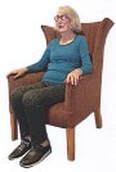
When a resident has difficulty rising from an armchair, consider the seat height, depth, width, slope and firmness, and the armrest height. 

When choosing an armchair for your residents consider these things: 
Picture
a) Height:  For comfort and ease of getting out of the chair:

  • allow a 90° angle at the hip, between the thigh and body 
  • feet need to rest comfortably on the floor 
  • have enough heel space under the chair for standing. 
 
 
b) Width: There needs to be a space of 2-3 fingers either side of the body to allow wriggle room and to keep the armrests comfortable. 
 
 
c) Depth: The depth needs to ensure a good upright posture and for ease
  • user’s bottom needs to be at the back of the chair while feet still on the ground 
  • ensure seat edges are curved to prevent pressure behind the legs. 
  • space between chair and back of the knees needs to be a 2-3 fingers space to avoid pressure behind the legs

Picture
d) Back rest  needs to: 

  • support the lower spine, neck and head 
  • be wide enough to support shoulders 
  • lean back only slightly 
 
 
e) Arm rests need to: 

  • support the forearms and hands without raising the shoulders 
  • allow a 90°angle at the elbow, between the forearm and upper arm 
  • be firm enough to help with standing 
f) The chair surface needs to: 

  • be comfortable and firm, for ease of getting out 
  • easily cleaned 
  • a fabric that won’t cause sweating 
 
Residents come in all shapes and sizes, we recommend Residential Providers 

  • purchase a range of different height, width and depth chairs 
  • use chair raisers for taller people
  • purchase chairs with height adjustable legs if possible
 
​Choosing wheeled chairs
 
For staff safety when choosing wheeled chairs, ensure the wheels are larger enough to push easily on all floor surfaces while allowing the ambulant person’s feet to rest on the floor so they can stand easily. If your current wheeled chairs are hard for staff to push, see if you can get larger castors or wheels, or check that fluff is not restricting the wheels..
 
Couches
 
We don’t recommend couches as they are harder to get out of and harder to assist someone to stand.  

September 20th, 2022

20/9/2022


Skin injuries caused by pressure
 

​For those of us caring for people who barely move or rely on others to move them, it is important to know how to best look after their skin. Pressure injuries, otherwise known as pressure areas, ulcers or bedsores, are among the negative effects of immobility.
 
What is a pressure injury?
 
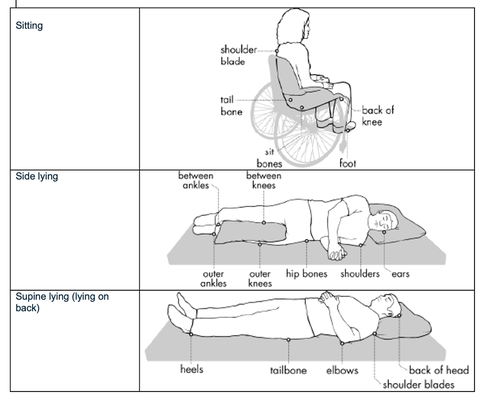
A pressure injury is damage to an area of skin, usually around a bony part of the body, which has been under pressure for some time. The pressure stops the blood flow feeding the skin in the area and if the pressure is not removed the skin will break down and eventually become an ulcer.  Friction from chaffing, or rubbing over these bony areas can also cause sores and ulcers.
 
What areas are prone to pressure injuries?
 
The diagrams below indicate where most pressure injuries generally occur, however people with unusual posture may develop them elsewhere.
Picture
Who is likely to develop pressure 
 
Anyone who is immobile or can’t feel any sensations are at serious risk, especially those who:
 
  • are bedridden after surgery or during a long illness
  • have a health condition such as diabetes, stroke, chronic obstructive airways disease and malnutrition
  • have had pressure injuries before
  • sit or lie in one position for hours because they can’t move themselves 
 
 
How will I know someone is developing a pressure injury?
 
The skin area around a bony part of the body may:
 
  • be discoloured - dark or red 
  • feel hard
  • be warm
  • not go white when pressed with your finger
  • have a blister, blood blister, crack or open wound
 
How can I prevent pressure injuries?
 
A pressure injury is serious, can take a long time to heal, and many are preventable.
 
We can help prevent pressure injuries by relieving direct pressure on the bony areas, taking good care of the skin and having a healthy diet and adequate fluids.  Here are a few tips:
 
Avoid direct pressure
  • change position regularly, at least two hourly
  • use special pressure-relieving mattresses and cushions
  • don't drag heels or elbows when moving, bathing or dressing 
  • make sure the bed sheets and clothes are smooth, not wrinkled 
  • use cotton or silk like fabric sheets and clothing
 
Skincare 
  • keep skin clean and dry
  • avoid scented soaps as they can be more drying
  • moisturise skin thoroughly after washing and keep well moisturised
  • avoid using talcum powder as this dries the skin’s natural oils
 
Diet
  • provide a well balanced diet
  • give at least two litres of fluid a day 
 

What should I do if you think a pressure injury is developing?
 
Immediately reposition the person to completely take all pressure off the affected area and follow all the prevention tips above.  Seek help from:  
 
  • their GP, who may refer to the community therapy or nursing team if required
  • Therapy Professionals Physio, Occupational Therapists and Dietitians.
 
How can Therapy Professional’s Therapists can help?
 
Our therapists can help with:
 
  • education on pressure injury prevention 
  • manage current or recurring injuries
 
Dietitians:  advise on:
  • nutritional requirements to aid wound healing. 
 
Occupational Therapists: advise on: 
  • pressure relieving products e.g. cushions, mattresses, heel protectors
  • positioning for pressure relief
 
Physiotherapists:  advise on:
  • moving and turning people in bed safely to avoid friction on the skin
  • changing position and movements to prevent staying in one position for too long.
 
If you require education on prevention and management of pressure injuries, our friendly Physio and Occupational Therapists and Dietitians can help, just contact us at Therapy Professionals. 
 
Ph:                 03 377 5280
Email             [email protected]
Website:       therapyprofessionals.co.nz


September 15th, 2022

15/9/2022

 
To Exercise or Not to Exercise?
That is the question
Picture
Here are a few tips to help you decide.

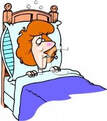
You have got a fever:
  • Stay home and rest so the body’s immune system is battling an infection – it doesn’t need the stress from exercise.
 
You’ve got a cold
  • You might feel miserable however you don’t have to rule out exercise.  Moderate intensity exercise is okay and doesn’t seem to make you sicker.  Just take it easier.
 
You’ve got the flu
  • Head for the sofa, do not exercise.  With flu comes a fever so heed the rule not to exercise with a fever. 
 
You’ve had a recent asthma flare up or chest infection
  • If the asthma is back under control – start exercising again gently.
  • Skip exercise if you have a chest infection (the fever rule), then start again gently

Picture
You’ve had a bad night and feel too tired
  • Get up and get moving!  It can boost your energy and help improve sleep.  
  • Constant fatigue can be a sign of illness so see your doctor.
 
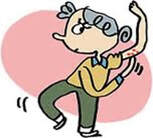
Your muscles are sore
  • Keep up the exercise – listen to your body and keep it gentle.
 
You’ve had a rough week
  • Exercise can help reduce stress and boost energy. Start with a gentle walk or exercise – and do more if you feel like it.
 
Don’t rush your comeback
  • If you have not exercised for some time, do exercise, but start gently and ease back into it (it takes a lot of energy to keep up muscle strength and fitness and very little time to lose it).
 

If you need any advice on what’s the best sort of exercise
for you we can help just contact us on
 
Ph:      (03) 377 5280                          Email:            [email protected]

September 06th, 2022

6/9/2022

 
Can people on Modified Diets have food treats?
 
At any celebration - Christmas, Birthdays and Easter, it’s common for us to have food treats like sweets and nuts.  Unfortunately we notice a great increase in choking incidents and chest infections caused by aspiration over holiday seasons, because people forget these treats are food.  
 
Yes, people on modified diets can have treats however they need to be modified in the same ways as their usual foods. 
 
In order to help you keep your clients safe from choking and chest infections our Speech Language Therapists have come up with a few alternatives for you to try.
Pureed diet (smooth and uniform texture)
  • chocolate sauce
  • flavoured toppings eg caramel, strawberry
  • melted chocolate – try adding a little whipped cream to help slow the resetting time
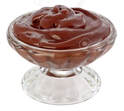
  • chocolate mousse
Minced and Moist diet:  (needs to be very finely cut or mashed).
 
All options suggested for a pureed diet plus:
  • finely grated chocolate
  • mashed cake or muffin with cream or yoghurt
  • trifle, tiramisu (with custard, cream or ice cream)
Easy to Chew diet: (must be able to be easily and cleanly cut with the side of a fork)
 
All of the options in pureed and minced and minced and moist plus:
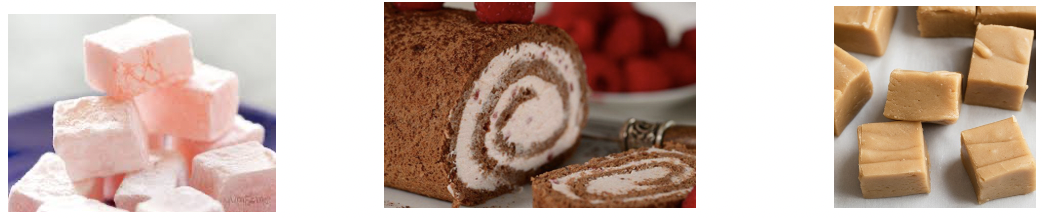
  • chocolate fudge
  • Russian fudge
  • some soft centred caramels
  • muffins or cake with cream or yoghurt
  • softened chocolate (placed in microwave until soft)
  • Turkish delight (made with jelly and icing sugar)
  • some soft lollies such as ‘bananas’ (test as if left out or shelved too long, they become hard.
​
This list is not a complete list; you may come up with some of your own ideas as long as what you’re giving your clients is the correct texture prescribed.
 If you require any assistance, our Speech Language Therapists can help.
 Just contact us:
 
                Phone:       03 377 5280                     Email: [email protected]
 

    Author

    Shonagh O'Hagan
    and Therapists at Therapy Professionals

    Archives

    November 2025
    October 2025
    September 2025
    August 2025
    July 2025
    June 2025
    May 2025
    April 2025
    March 2025
    February 2025
    January 2025
    December 2024
    November 2024
    October 2024
    September 2024
    August 2024
    July 2024
    June 2024
    May 2024
    April 2024
    March 2024
    February 2024
    January 2024
    December 2023
    November 2023
    October 2023
    September 2023
    August 2023
    July 2023
    June 2023
    May 2023
    April 2023
    March 2023
    February 2023
    January 2023
    December 2022
    November 2022
    October 2022
    September 2022
    August 2022
    July 2022
    June 2022
    May 2022
    April 2022
    March 2022
    February 2022
    January 2022
    December 2021
    November 2021
    October 2021
    September 2021
    August 2021
    July 2021
    June 2021
    May 2021
    April 2021
    March 2021
    February 2021
    January 2021
    December 2020
    November 2020
    October 2020
    September 2020
    August 2020
    July 2020
    June 2020
    May 2020
    April 2020
    March 2020
    February 2020

    All

    RSS Feed

Quick Links
Physiotherapy
Speech-Language Therapy
Music Therapy
Occupational Therapy
Dietetics
Phone: (03) 377 5280
Email:   [email protected]
Hours:  8:30am-4pm, Monday-Friday
Office: 12 Coronation St, Christchurch 
Postal address: PO Box 7807,
​                             Christchurch 8240
Disclaimer
Therapy Professionals makes every effort to ensure that the information provided on its web pages is accurate and up-to-date. Website content is subject to regular review and no warranty can be provided regarding the accuracy of it. © Therapy Professionals Ltd 2015. All rights reserved.