Therapy Professionals

  • Home
    • History >
      • Cantabrainers Choir
      • Tribute to Clare O'Hagan
    • Client Information
    • Rights and Responsibilites
    • Careers
    • Testimonials
  • Services
    • Assessment, Treatment & Consultation
    • Workplace/home safety
    • For organisations
    • Nail Trimming
  • Therapies
    • Physiotherapy
    • Speech-Language Therapy >
      • Communication
      • Swallowing
    • Music Therapy
    • Occupational Therapy
    • Dietetics
  • Gift Vouchers
  • Contact
  • Information
    • Information and Handy Hints
    • Blog
    • Links
    • Facebook
    • Events
    • Newsletters
  • Home
    • History >
      • Cantabrainers Choir
      • Tribute to Clare O'Hagan
    • Client Information
    • Rights and Responsibilites
    • Careers
    • Testimonials
  • Services
    • Assessment, Treatment & Consultation
    • Workplace/home safety
    • For organisations
    • Nail Trimming
  • Therapies
    • Physiotherapy
    • Speech-Language Therapy >
      • Communication
      • Swallowing
    • Music Therapy
    • Occupational Therapy
    • Dietetics
  • Gift Vouchers
  • Contact
  • Information
    • Information and Handy Hints
    • Blog
    • Links
    • Facebook
    • Events
    • Newsletters

Information and Handy Hints

July 27th, 2023

27/7/2023


Nurse led foot care: Managing toenails in elderly

and 
disabled patients.


​Introduction
 
Registered nurses as leaders in assessment and care planning are in a position to make a substantial difference to the health, wellbeing, and safety of patients.  Elderly and/or disabled patients often present with foot conditions which they find difficult to manage and may initially look to primary healthcare services for information regarding how best to care for their feet. The purpose of this article is to raise awareness for registered nurses regarding the importance of foot health, and to showcase a nurse entrepreneur.
 
Challenges: Why foot care may be difficult to manage
 
“Foot Care is a very important part of Personal Care, especially for those who are unable to care for their own feet due to comorbidity such as diabetes, or advanced age.” (Waitemata District Heath Board, 2018). Anyone who has damaged their own toe will agree, there’s no doubt that foot hygiene and health is important for a sense of well-being and has a significant impact on comfort and mobility. 
 
Research supports the fact that 80% of people over the age of 80 years find managing their nails difficult (Harvey, Frankel, Marks, Shalom & Morgan, 1997).  This may be due to poor eyesight, poor balance, reduced flexibility, arthritis, obesity, shortness of breath, pain, tremor, weak hand muscles, dizziness or other chronic health conditions such as diabetes (Daly et. al., 2014) or rheumatoid arthritis (Rome, Gow, Dalbeth & Chapman, 2009).
 
As a result, there may be problems with the feet such as overlapping toes, tenderness, or open areas.  Nails may also present problems with shape, thickness, fungal infection, or edges that are prone to in-grow.  Previous injury to feet, toes, or nails can also make them difficult to manage.   Nail care is an important part of personal care, and registered nurses are in a pivotal position (Daly et. al., 2014) to help meet challenges that increasing demand for assistance with personal care and support care for our aging population presents (University of Auckland, 2017).
 
Risk related to unidentified need for assistance with foot care:
 
Pain: The patient may be suffering pain from long nails dragging on sheets, carpet, socks, or shoes. Long toenails may be digging into the toes in various ways.  Corn or calluses may be present on the toes or soles, making each step a challenge.
 
Reduced mobility: this pain can result in reduced or unstable mobility, which can negatively affect quality of life, independence, exercise, concentration, demeanour, and mood.
 
Injury: long toenails can cut either the underside of the toe if they curl under, or the side of an adjacent toe.
 
Accidental injury: People accidentally cut their toes when they are trying to cut their toenails, unfortunately these injuries can become infected, or in the case of patients with diabetes (Daly et. al., 2014) extremely difficult to heal. Keller-Senn, Probst, Imhof, and Imhof (2015) note that any changes in feet, nail and skin of patients can become established if circulation to the feet and toes is compromised, resulting in amputations that could have been avoided.
​Practicalities: What you can do to help

There are a number of simple, practical ways to assist with foot care. Number one is regular assessment of the feet of people with diabetes (Keller-Senn et. al., 2015), or patients who complain about painful feet, nails, or other related issues. This is a significantly important part of patient assessment. Nurses are then able to provide these assessments and then plan care, monitoring and guidance regarding foot care. This may include advocating regular professional foot care or referral to a specialist provider.
 
As part of the holistic care you provide, you should often ask elderly and disabled patients how they manage their foot and nail care, undertake a general assessment and discuss ongoing management options with them.
 
Process: Access to Foot Care Providers:
 
There are a variety of foot care services in the general community, including podiatry clinics, community foot care clinics, beauty therapy clinics, and visiting registered nurses providing basic foot care in the home. Clients may need assistance from a GP or practice nurse (Keller-Senn et. al., 2015) to access the services.
 
Procedure:
Any initial registered nurse assessment (Rome et. al., 2009) of feet and nails should include, contact details, clinical history and expectations. Examine skin, feet, toes and legs for colour, oedema, inflammation, deformity, pain, thickness, brittleness, shape, contour, and infection. A plan of care is discussed with the client regarding the immediate needs and ongoing care of their feet and nails.
 
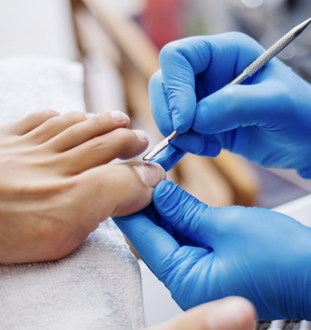
Basic foot care includes: trimming and filing of toenails, reduction of corns and calluses, cleaning and dressing of any open areas and sanitiser with moisturiser is applied to the feet and toes. Cream may be massaged into dry skin. Fingernails may be cut and filed at the same time that Food Care is provided, if requested by the client and/or offered by the service provider.
 
Ongoing care a follow-up appointment may be made at either a 4-6-8 or 12 week intervals, dependent upon client requirements, or a client may be directed to a Mobile Foot Care Community Clinic if they wish to explore that option.
 
Cost:
The cost of footcare may range from $45 to $105 per visit or $25 at a Community Clinic. 
Clients with Diabetes can access some free foot care from a Podiatrist via a GP referral.
WINZ may reimburse foot care costs using the Disability Allowance via receipt.
ACC: http://www.acc.co.nz/im-injured/injuries-we-cover/treatment-we-pay-for/ and
Veterans Affairs: http://www.veterans.gc.ca/eng/about-us/policy/document/1239/ will provide free Foot Care with GP referral.
 
Clinical Example:
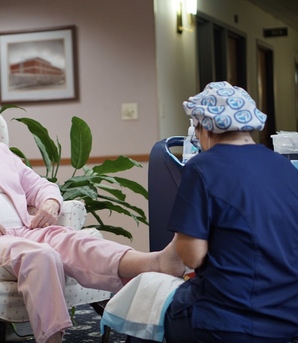
Mobility community foot care clinic: Registered Nurse provider.
 
I am a registered nurse based in the Canterbury region. Requests for affordable foot care for people unable to travel to clinics were received from GPs and practice nurses were made directly to me. This section describes my journey in setting up and managing “Mobile Foot Care”.
 
I initially had to invest time and finances to prepare for the role by working as a Foot Care Assistant with a Podiatrist for a year. During this time, I learned basic foot care, including care of nails, corns, and calluses. The training Podiatrist was enthusiastic and supportive about a registered nurse providing a low cost, mobile, domiciliary foot care service, because he could see the need for it and believed that Podiatrists would not be interested in providing such a service. I would refer clients needing advanced care back to him.
 
There is certainly benefit in a registered nurse providing this service, and combining nursing knowledge, assessment skills and nursing philosophy within a Foot Care Service. As a registered nurse I can also assess, plan, evaluate and understand specific, unusual or challenging needs or behaviours related to disabilities such as physical, psychiatric, neurological, sensory, intellectual disability or dementia.
 
At the time of my preparation, I also completed a Person-Centred Counselling Diploma at Christchurch Polytech which fine-tuned my ability to listen and respond effectively during the inevitable conversations which arise during home visits (New Zealand Nursing Review, 2014). Broader health related questions often arise, providing the opportunity for health educations and if required, referral to a GP or other Health Service.
 
The home visit by a friendly, professional registered nurse is often as valued by the client as much as the foot care. Patients have reported a feeling of total wellbeing following the consultation, not just the fact that their feet feel much better.
 
Community Foot Care Clinics:
At the request of a rural GP, I established community Foot Care Clinics in Kaiapoi and Christchurch, which I run one day per month. In this service, which is a minimal charge, toenails and fingernails are cut and filed, and feet receive basic foot care. 
 
Collaborative approach:
Foot care involves liaison between many health professionals. Including GP’s, practice nurses, district nursing, hospitals, occupational health, palliative care, ACC, aged and residential care facilities, podiatrists, chemists, carers, beauty therapists, emergency care workers, diabetes centre, elderly day care centre staff, and social services. Nurses retain a pivotal role in helping to coordinate and plan (Keller-Senn et. al., 2015).
 
Foot care services are currently being reviewed in other regions of the country (Waitemata District Heath Board, 2018), though not using Registered Nurses. 
 
Education for registered nurses in basic and advanced foot care:
The Ontario College of Health Studies in Canada has a well-stablished Foot Care Nurse System and offers online education (College of Health Studies, 2018) to registered nurses and nurse practitioners worldwide.
 
Profile:
Heather Woods is a Registered Nurse clinical nurse specialist who has been operating Mobile Foot Care for 28 years, it is a private business based in North Canterbury.
 
References
 
College of Health Studies (2018). Basic and Advanced Nursing Foot care Competencies and Standards. Retrieved from http://www.collegeofhealthstudies.com/footcarenurseprogram/footcarenursestandards.html.
Daly, B., Arroll, B., Sheridan, N., Kenealy, T., Stewart, A., & Scragg, R. (2014). Foot examinations of diabetes patients by primary health care nurses in Auckland, New Zealand. Primary care diabetes, 8(2), 139-146.
Harvey, I., Frankel, S., Marks, R., Shalom, D., & Morgan, M. (1997). Foot morbidity and exposure to chiropody: population-based study. BMJ 315(7115), 1054-1055.
Keller-Senn, A., Probst, S., Imhof, R. M., & Imhof, L (2015). Nurse-led education programme enhancing foot care self-efficacy in high-risk diabetes population: pilot randomised controlled study. International Diabetes Nursing, 12(2), 74-78.
New Zealand Nursing Review. (2014). Faith, duty and foot pampering winds nurse QSM. New Zealand Nursing Review, 14(3), 15.
Peterson, J. M., & Virden, M. D. (2013). Improving diabetic foot care in a nurse-managed safety-net clinic. Journal of the American Association of Nurse Practitioners, 25(5), 263-271.
Rome, K., Gow, P. J., Dalbeth, N., & Chapman, J. M. (2009). Clinical audit or foot problems in patients with rheumatoid arthritis treated at Counties Manukau District Health Board, Auckland, New Zealand. Journal of foot and ankle research, 2(1), 16.
Soliman, A., & Brogan, M. (2014). Foot assessment and care for older people. Nursing Times, 110(50), 12-15.
University of Auckland. (2017). Report finds our ageing population will need increased levels of care. Retrieved from http://www.auckland.ac.nz/en/about/news-events-and-notices/news/news-2017/04/aging-population-will-need-increased-care-levels.html


Comments are closed.

    Author

    Shonagh O'Hagan
    and Therapists at Therapy Professionals

    Archives

    December 2025
    November 2025
    October 2025
    September 2025
    August 2025
    July 2025
    June 2025
    May 2025
    April 2025
    March 2025
    February 2025
    January 2025
    December 2024
    November 2024
    October 2024
    September 2024
    August 2024
    July 2024
    June 2024
    May 2024
    April 2024
    March 2024
    February 2024
    January 2024
    December 2023
    November 2023
    October 2023
    September 2023
    August 2023
    July 2023
    June 2023
    May 2023
    April 2023
    March 2023
    February 2023
    January 2023
    December 2022
    November 2022
    October 2022
    September 2022
    August 2022
    July 2022
    June 2022
    May 2022
    April 2022
    March 2022
    February 2022
    January 2022
    December 2021
    November 2021
    October 2021
    September 2021
    August 2021
    July 2021
    June 2021
    May 2021
    April 2021
    March 2021
    February 2021
    January 2021
    December 2020
    November 2020
    October 2020
    September 2020
    August 2020
    July 2020
    June 2020
    May 2020
    April 2020
    March 2020
    February 2020

    All

    RSS Feed

Quick Links
Physiotherapy
Speech-Language Therapy
Music Therapy
Occupational Therapy
Dietetics
Phone: (03) 377 5280
Email:   [email protected]
Hours:  8:30am-4pm, Monday-Friday
Office: 12 Coronation St, Christchurch 
Postal address: PO Box 7807,
​                             Christchurch 8240
Disclaimer
Therapy Professionals makes every effort to ensure that the information provided on its web pages is accurate and up-to-date. Website content is subject to regular review and no warranty can be provided regarding the accuracy of it. © Therapy Professionals Ltd 2015. All rights reserved.